If you’ve ever walked into a recording studio, a cozy café, or a home theater, you’ve probably noticed acoustic panels tucked into walls, ceilings, or even hanging from the ceiling to tame echo, reduce reverberation, and make sound feel balanced. But if you’ve shopped around for these panels yourself, you might have stumbled on two main types: 2D and 3D acoustic panels. At first glance, they might look similar—both are designed to improve sound quality—but the differences between them go far beyond just shape. As a supplier who’s worked with architects, musicians, café owners, and home DIYers for years, I’ve heard so many people mix these up, choosing the wrong panel for their space and ending up with less-than-ideal sound. Let’s break this down in plain terms, no confusing jargon, so you can pick what’s right for your next project. Acoustic Panel Wall Panel
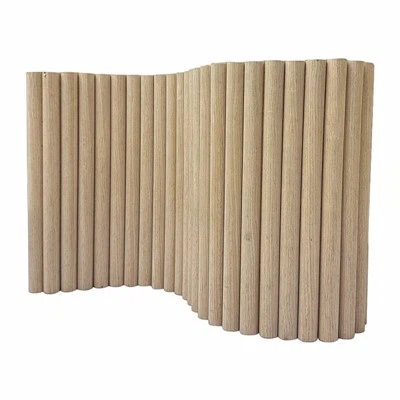
First, let’s start with the basics: what even is an acoustic panel? At their core, acoustic panels are sound-absorbing materials, usually made from dense, porous materials like foam, fiberglass, or recycled wool. Their job is to catch sound waves, stop them from bouncing around walls and creating that muddy, echoey noise that makes conversations hard to follow or music sound muddled. The key difference between 2D and 3D panels is how they’re structured. A 2D acoustic panel is a flat, two-dimensional shape—think a rectangle, square, or even a simple curved shape that only changes along one plane, no depth that extends out away from the wall. Most standard acoustic panels you see in home offices or small studios are 2D: they’re mounted flush against the wall, lie flat, and have a uniform thickness across their entire surface.
A 3D acoustic panel, on the other hand, has intentional, protruding three-dimensional elements that stick out from the wall or surface it’s mounted on. These can be ridges, pyramids, cubes, waves, or even custom shapes like hexagons that have a distinct height or depth away from the wall. That extra depth isn’t just for looks—It’s a game-changer for how the panel interacts with sound waves.
Now, let’s talk about how they perform when it comes to absorbing sound. The science of sound absorption relies on something called sound frequency: low frequencies (like the deep bass from a speaker or the rumble of a fridge) are longer waves, while high frequencies (like a bird chirp or a singer’s high note) are shorter. For any acoustic panel to work well, it needs to match the depth of its material to the wavelength it’s trying to absorb. That’s why thickness matters, but shape amplifies that.
2D panels, being flat, have a consistent depth (usually between 1 and 4 inches, depending on the material) across their entire surface. They’re really good at absorbing mid-range frequencies, which are the most common in everyday speech, background noise, and most music. If you’re working on a small home office where you take Zoom calls and just need to cut down on that echo that makes your speech sound distorted, a standard 2D panel will do the job. They’re affordable, easy to install, and you can cover a lot of wall space quickly, which is great for small to medium spaces where cost and simplicity are priorities.
But here’s where 3D panels pull ahead: that protruding depth changes the effective thickness of the panel at different points across its surface. For example, a pyramid-shaped 3D panel has a peak that sticks out 3 inches from the wall and a base that’s flat against the wall, so the effective depth ranges from 0 inches at the base to 3 inches at the peak. This multi-depth design lets 3D panels absorb a much wider range of frequencies—from crisp high notes to the low, booming bass that 2D panels often struggle with. I’ve seen this play out a lot in small studios where musicians complain that their bass is muddy. Adding a few 3D panels instead of just 2D ones cuts down that boom without making the space feel dead or flat. Also, 3D panels tend to diffuse sound a little, not just absorb it—so they spread sound evenly throughout a room instead of just soaking it up. That’s perfect for larger spaces like cafes, community centers, or home theaters where you want music or speech to sound consistent no matter where you’re sitting.
Next, let’s talk about installation and flexibility. 2D panels are as simple as it gets. Most of them come with pre-drilled holes or adhesive strips, so you can just stick them or screw them straight onto any flat wall. They’re lightweight, too, so you don’t have to worry about reinforcing drywall. If you’re a DIYer or someone who wants to swap panels out later, 2D panels are way easier to reposition. Their flat shape also makes them great for covering large, empty wall areas that are prone to echo—like a blank wall in a basement or a conference room with too much hard surface.
3D panels, because of their shape, are a little trickier to install. That protruding depth means you’ll need at least 3 inches of clear space between the back of the panel and the wall to mount it correctly. That sounds like a small detail, but if your walls have pipes or wiring sticking out, you’ll have to adjust, or you’ll lose that extra depth that makes the panel work. Also, their uneven shape means you can’t just stick them on with basic adhesive—you’ll need heavy-duty screws or mounting brackets to hold the weight of the protruding shapes, especially for larger panels. But that extra installation work pays off in flexibility. Because they don’t have to be flush against the wall, you can mount them in corners, from ceilings, or even as freestanding baffles in the middle of a room, which is great for spaces where you don’t want to clutter up walls with panels. For example, a café with open floor plans doesn’t want every wall covered with flat panels—hanging 3D pyramid panels from the ceiling above tables keeps sound balanced without ruining the interior design.
Design is another big factor that people overlook. These days, acoustic panels aren’t just for functional purposes—they’re a design feature that ties a space together. 2D panels are understated, for better or worse. Most are plain fabric-wrapped rectangles, so they blend into the background. If you’re working on a minimalist home office or a small studio where you don’t want panels to stand out, 2D panels are a safe choice. But if you’re designing a retail space, a boutique hotel lobby, or a creative studio that wants panels to add a modern, textured element to the room, 3D panels are the way to go. Their shapes—waves, hexagons, chevrons, even custom prints—add visual interest while they do their job. I had a client who ran a record store; they didn’t want plain black 2D panels, so we worked with them to get custom 3D panels with a vintage vinyl pattern printed on the fabric. They absorbed the excess bass from the speakers and became a talking point for customers. That’s a win no flat panel could deliver.
Cost is a consideration too, and it’s not as straightforward as you might think. 2D panels are generally cheaper upfront. A standard 24×48 inch 2D panel costs between $30 and $60, depending on the material. For a small space like a 100-square-foot home office, you might need 4 to 6 panels, which adds up to around $150 to $300. 3D panels are more expensive per panel—same size 24×48 inch 3D panel can run between $50 and $100, because of the extra material and manufacturing for the 3D shape. But here’s where it balances out: because 3D panels are more effective at absorbing a wider range of frequencies, you might not need as many of them. For a medium-sized studio, you might need 4 3D panels instead of 6 2D panels, so total cost could end up being similar or even lower, depending on your space. Also, if you’re working on a commercial project, the energy and time saved from better sound quality (no more customer complaints about echo, no need to redo sound design later) can offset the initial cost.
Wait, but let’s clear up a common misconception: are 3D panels always better? No, not for every space. If you’re working on a tiny 8×10 home office where the main issue is echoing on conference calls, a set of 2D panels will work just fine, and you won’t have to deal with the extra installation hassle of 3D. If you’re on a tight budget and just need to tame a small echo, 2D is the smart pick. But if you’re designing a space over 200 square feet, a room where you play music regularly, or a commercial space where sound quality impacts customer experience, 3D panels are worth the extra investment.
Another thing to mention: durability. Both types of panels are made to be durable, but 3D panels tend to hold up a little better in high-traffic areas. Their protruding shapes are less likely to get dinged or damaged if something bumps into them, whereas flat 2D panels can get scuffed or punctured easily if they’re in a busy space. I’ve had café clients tell me that 3D panels near entryways have lasted twice as long as the 2D panels we installed in the same spot a few years back.

At the end of the day, choosing between 2D and 3D acoustic panels comes down to three things: your space size, your sound needs, and your design and budget. If you’re still not sure which is right for you, our team works with clients every day to walk through their space, their goals, and what they want to get out of their acoustic treatment. We don’t push one type over the other—we just help you pick what will make your space sound and look its best. To discuss your project and get a tailored recommendation, reach out to our team for a consultation. We’re here to answer all your questions, no jargon, no pressure.
Acoustic Panel Wall Panel References:
- Acoustical Society of America. (2020). Sound Absorption Characteristics of Porous Materials. Journal of the Acoustical Society of America.
- International Energy Conservation Code. (2021). Acoustic Treatment Guidelines for Commercial and Residential Spaces.
- National Association of Music Merchants. (2019). Acoustic Panel Performance for Recording and Performance Spaces.
- Architectural Acoustics Today. (2022). Design Considerations for 2D vs. 3D Acoustic Panels in Interior Design.
Linyi Zhongjia New Building Materials Co., Ltd.
As one of the most professional acoustic panel wall panel manufacturers in China, we offer a wide range of products with superior quality. Please rest assured to buy high-grade acoustic panel wall panel for sale here from our factory. We also accept customized orders.
Address: 6th Floor, Building B03, Lushang Center, Liuqing Street, Lanshan District, Linyi City, Shandong Province
E-mail: zhongjiafactory@gmail.com
WebSite: https://www.zjwalldecor.com/
