If you’ve ever dived into fiber optic networking—whether you’re building data centers, upgrading campus infrastructure, or troubleshooting a tricky server rack setup—you’ve probably stumbled across MTP and MPO connectors. As someone who’s been working with fiber for over a decade (and running an MPO/MPT fiber optic cable supply company), I can’t tell you how many times I’ve gotten questions about the difference between their quality. It’s not just a “which is better” debate; it’s about how their build directly impacts your network’s performance, longevity, and even your bottom line. Let’s break this down like we’re chatting over coffee, no jargon overload, just real talk from someone who sees these connectors roll off the line every week. MPO/MPT Fiber Optic Cable
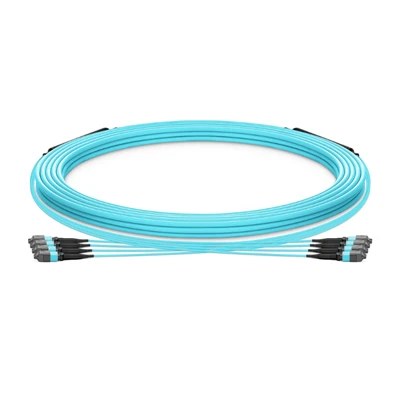
First, let’s get the basics straight because even seasoned folks mix these up sometimes. MPO stands for Multi-fiber Push On, right? It’s the older workhorse—originally designed for parallel fiber connections, most often used in 10G, 40G, and 100G base networks. MTP, on the other hand, is a branded, improved version of MPO, developed by US Conec (yeah, the name’s a big one in the game) to fix a lot of the quality flaws that plagued early MPO connectors. But here’s the thing: most people don’t realize that “MPO” isn’t a single standard—it’s a generic term for any multi-fiber push-on connector, which means quality can vary wildly from one budget brand to another. MTP, though, is a registered trademark, so it’s built to strict, consistent specs from the get-go. That’s where the quality gap starts, but let’s dig into the details that actually matter for your setup.
Let’s start with the core part of any fiber connector: the ferrules. That’s the tiny ceramic (usually zirconia) tube that holds each fiber strand in place. For multi-fiber connectors like these, ferrules are super critical because if even one fiber is off-center, your signal can drop, leading to packet loss or slower speeds. Bad MPO connectors often have ferrules with inconsistent hole sizes or rough inner walls—like, imagine trying to thread a needle through a hole that’s lopsided; the fiber kinks or sits crookedly. MTP ferrules, though, use precision molding and lapping processes that’re calibrated to way tighter tolerances. I’ve tested samples where a budget MPO had ferrule misalignment of up to 3 microns, while a quality MTP is under 1 micron. That might sound trivial, but for a 12-fiber or 24-fiber trunk cable, that misalignment adds up across every strand—you’re looking at 12 tiny errors that can turn into a full network hiccup during peak hours.
Then there’s the housing and latching mechanism. MPO connectors usually have a basic plastic housing (sometimes low-grade plastic, even) with a simple push-on latch. The problem here is that the latch can wear out after a few insertions—like, if you’re plugging and unplugging cables for maintenance, the latch might slip, leaving a loose connection. Loose connections are the #1 cause of fiber outages, trust me. MTP’s housing is made from a more durable engineering-grade plastic (usually polycarbonate with fiber reinforcement) and the latching system is designed for multiple insertions—we’re talking hundreds, not a dozen. I remember a client who bought cheap MPO cables for a new data center; after just 3 months of routine checks, 17 out of 48 MPO connectors had broken latches, leading to random downtime. Swapping them for MTP connectors fixed that—no more latch failures, even after monthly maintenance.
Another big one: fiber alignment keys. Both connectors use a key to make sure you don’t insert them backwards (which would flip the fiber pairs and kill your signal), but the quality of that key varies wildly. Cheap MPO keys are molded roughly—they’re a bit off-size, so sometimes you can force them in backwards, or they’re loose and wobbly once inserted. MTP keys are precision-machined, so they fit snugly only in the correct orientation. No more accidentally reversing fibers during installation, which saves you from the nightmare of having to trace every single fiber in a 24-fiber cable just to find the flipped pair.
Wait, let’s talk about something that’s often overlooked but makes a huge difference in the field: environmental resistance. If you’re running cables in outdoor plant rooms, dusty server closets, or areas with temperature swings (like basements that get cold in winter), your connectors need to hold up. Low-quality MPO connectors don’t have proper sealing—dust and moisture can get inside the ferrule end, leading to signal attenuation over time. MTP connectors come with a standard sealing gasket that keeps contaminants out, which is why they’re more reliable in harsh environments. We’ve had clients run MTP cables in outdoor fiber runs for 5 years without any signal issues, while a client using budget MPOs had to replace connectors every 18 months because of moisture damage.
Now, let’s get to the cost part, because I know budget is a concern for everyone. A lot of folks see MTP connectors as more expensive and try to go with cheap MPOs, but here’s the catch: the total cost of ownership (TCO) is way lower with quality connectors. Let’s do a quick breakdown: a budget MPO 12-fiber connector might cost $2 each, but if they fail after 50 insertions or 6 months of use, you’re replacing them constantly. An MTP connector is $5 each, but it’s designed for 500+ insertions and lasts 5+ years. Multiply that over a data center with 1,000 connectors—you’re looking at $2,000 upfront for MPOs vs. $5,000 for MTPs, but after 2 years, the MPOs have cost you $8,000 in replacements and downtime, while the MTPs are still going strong. That’s not a math mistake—downtime costs can be huge, especially for businesses that run 24/7. I’ve had clients tell me that a single hour of downtime costs them $100k+, so avoiding that with a more reliable connector is a no-brainer.
But wait—does that mean MPO is always bad? No, not at all. The key is that “MPO” is a category, not a quality grade. There are high-quality MPO connectors that meet Telcordia standards (the industry’s go-to for fiber performance) that are great for short-term deployments or projects where budget is tight but reliability matters. The problem is that a lot of suppliers sell generic MPOs as “high-performance” when they’re not, so you have to check specs. MTP, though, is a standardized, quality-controlled product—you don’t have to guess if it’s going to work, because it’s built to a specific set of rules. That’s why a lot of network engineers prefer MTP for core backbones, even if it’s a bit more expensive.
Another point: mating performance. When two connectors are mated, the amount of light that passes through (insertion loss) is the measure of how good the connection is. Bad MPOs can have insertion loss of up to 0.5 dB, while MTPs typically have less than 0.3 dB. For high-speed networks (40G, 100G, 400G), that extra 0.2 dB might not sound like much, but it adds up across multiple connections. If you have 10 mated connectors in a trunk, that’s 2 dB of extra loss with cheap MPOs—enough to cause errors in high-speed signals. MTP’s lower insertion loss means your signal stays strong all the way to the end device, so you don’t have to add costly amplifiers or repeaters.
Let’s also talk about termination consistency. Terminating a multi-fiber connector isn’t like terminating a single LC connector—it’s way more work, and if the connector’s quality is low, the termination is less consistent. With cheap MPOs, two techs terminating the same cable might get different insertion loss readings every time. With MTP, because the ferrules and housing are so consistent, a single termination tech can get the same low loss every time, and two different techs will get almost identical results. That saves time during installation—fewer re-terminations, faster project completion, lower labor costs. I’ve seen a client cut termination time by 30% just by switching from budget MPOs to MTPs, because they didn’t have to waste time redoing bad terminations.
Now, what about common myths? Some folks say “MPO and MTP are interchangeable” which is sort of true—you can mate an MPO to an MTP, but only if it’s a quality MPO. But if you mate a cheap MPO to an MTP, you’ll get higher insertion loss and possible signal errors, because the MPO’s ferrule isn’t aligned the same way as the MTP’s. Also, some people think MTP is just a rebranded MPO, but that’s not accurate—US Conec actually patented the MTP’s ferrule design and latching system to fix the flaws in original MPOs. It’s not just a name change; it’s a significant upgrade.
So, when you’re choosing between MPO and MTP (or just making sure the MPOs you’re buying are up to snuff), here’s a quick checklist to keep in mind:
- Check the ferrule tolerance: Look for connectors with <1 micron ferrule misalignment.
- Latching mechanism: Make sure it’s engineering-grade plastic, not cheap injection-molded plastic that can break easily.
- Insertion loss specs: Aim for <0.3 dB when mated, per industry standards.
- Environmental sealing: If you’re running cables in dusty or temp-variable areas, get connectors with a sealing gasket.
- Insertion cycle rating: Look for 500+ insertions, not just 10 or 20.
As a supplier, I’ve seen every kind of connector out there, and I can tell you that the worst mistake a network builder can make is skimping on connector quality. It’s easy to look at the upfront cost and go for the cheapest option, but that cheap choice can lead to downtime, extra labor, and higher long-term costs. MTP might have a higher upfront price, but it’s a investment in your network’s reliability and performance that pays off over time.

If you’re not sure which connector is right for your setup—whether you’re building a new data center, upgrading your campus network, or troubleshooting an existing issue—reach out. I’ve worked with small businesses, big enterprises, and even telecom providers, and I can help you pick the right MPO or MTP connectors that fit your needs and budget. No sales pitch, no pressure, just honest advice from someone who knows fiber connectors inside and out.
Fiber Optic Box References
- Telecommunication Industry Association (TIA) Standard TIA-568-C.3, Optical Fiber Cabling Components Standard
- US Conec MTP Connector Product Specification, Revision 4.2
- Fiber Optic Association (FOA) Tutorial: Multi-fiber Connectors (MPO/MPT)
- Data Center Infrastructure Institute (DCII) 2023 Report on Fiber Connector Reliability for High-Speed Networks
Shenzhen Dimi Telecommunications Co., Ltd.
As one of the most professional MPO/mpt fiber optic cable manufacturers and suppliers in China, our products have good reputation in the market. Please rest assured to wholesale advanced MPO/mpt fiber optic cable made in China here from our factory. Also, custom service is available.
Address: China
E-mail: sales@dimifiber.com
WebSite: https://www.dimi-fiber.com/
